
I’ve spent most of my working life building websites whose whole purpose was to get clicked. So I understand why the SEO industry is in mourning. The click was the unit of everything: traffic, rankings reports, the chart that went up and to the right in the quarterly review. And AI Overviews have taken a chainsaw to it.
But I think the grief is getting in the way of the obvious next question, which is: who are the clicks going to now, and how do we become them?
The numbers are bad
Pew Research watched hundreds of US adults make tens of thousands of Google searches in March 2025. When an AI summary appeared, people clicked a normal result about half as often. Clicks halved. Hardly anyone clicked the links inside the summary, and a lot more people simply stopped searching there.
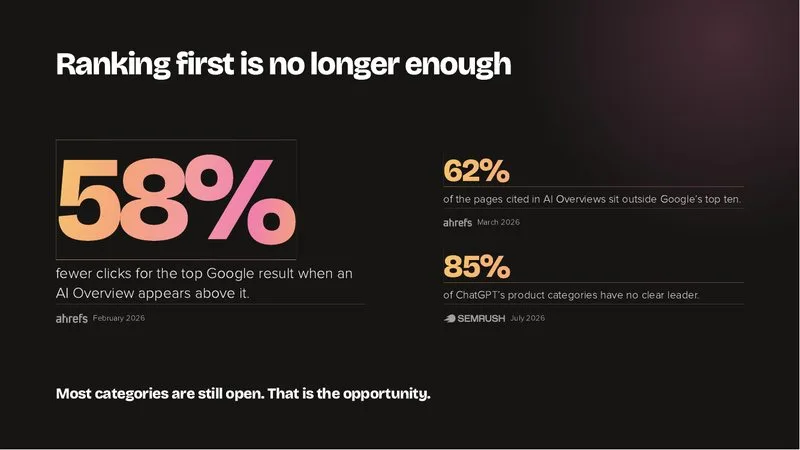
Ahrefs put numbers on what that does to the top spot. In April 2025 it found an AI Overview took about a third of the clicks off the top-ranking page. By early 2026 it was more than half. Seer Interactive tracked it across dozens of companies and saw organic clicks on those searches fall by about two thirds in just over a year. Paid clicks fell even further.
And this is now most searches that matter. Ofcom says about a third of UK Google searches show an AI Overview and around half of UK adults see them often. Bain found back in late 2024 that most consumers already relied on zero-click results for a good chunk of their searches, and reckoned it was knocking somewhere between a sixth and a quarter off organic traffic. Similarweb found zero-click news searches went from just over half to more than two thirds in the year after AI Overviews launched. That’s a big drop.
Where the clicks went
But Google hasn’t stopped sending traffic. In its Q2 2026 results, Sundar Pichai said Google is “now sending billions of clicks to websites every week through AI features in Search”. So the clicks still exist. They’re just going to a much smaller group of sites, the ones the AI quotes.
Seer Interactive’s data makes that concrete. When you’re cited in an AI Overview, you get about a third more organic clicks and nearly twice the paid clicks than when you’re not cited at all. So the same query, with the same AI Overview on top, is a drain for the brand that isn’t in it and a gain for the brand that is.
And being cited is not the same thing as ranking. Ahrefs looked at millions of AI Overview citations in March 2026 and found fewer than four in 10 were in the top 10 results. A year earlier it had been around three quarters. So most of what AI Overviews now quote comes from outside page one. Ranking first and being the source have come apart, and the second one is the one that still pays.
The clicks that are left are worth more
This is the bit that cheers me up. The informational, bouncy, read-one-paragraph-and-leave click is the one that died. The click that survives is from someone who has already had the AI narrow it down and now wants to buy.
Semrush worked out that the average visitor from an AI search source is worth more than four times the average visitor from traditional organic search, based on conversion rate. Adobe’s data on more than a trillion visits to US retail sites found AI traffic roughly quadrupling in a year to early 2026 and, by March 2026, converting about 40% better than other visitors. A year earlier it had converted worse, so this flipped fast. In the UK, Adobe’s August 2026 report had AI referral traffic to retail sites up about 15 times since October 2024 and converting about a fifth better than non-AI channels. Salesforce found shoppers referred from AI search over Christmas 2025 converted nine times more often than shoppers from social media.
Then there’s the traffic your analytics will never attribute. Similarweb found that being recommended in AI makes someone more than twice as likely to visit your site in the next week, that more than half of those visits arrive via branded search, and that those visitors look at nearly twice as many pages and stay twice as long. The AI did the persuading. You get the customer, labelled as “direct” or “organic brand”, and your dashboard shrugs. So you get fewer clicks, but better ones, and you can’t see a chunk of them.
How you become the source
Hacks won’t do it, as I keep saying. From the research I trust, three things matter, in this order.
Be mentioned, a lot, by sources the AI reads. Ahrefs’ study of tens of thousands of brands found web mentions matter about three times as much as backlinks for AI Overview visibility. For ChatGPT, Muck Rack found more than four in five citations are earned media. This is digital PR, pointed at the publications and communities the AI actually cites rather than at domain authority. We did exactly this for Clifton Private Finance, a specialist bridging finance brand: expert-led finance PR in nine trusted national and finance publications, and the brand surfaced in AI search for five high-intent bridging loan queries, with 21 cited sites in the top source panels. It was the right coverage in the right places.
Rank for what you sell. Seer Interactive found page-one rankings were the strongest predictor of ChatGPT mentions. SEO still matters, because it’s now the entry ticket.
Be quotable. A page that answers the question in one clear paragraph near the top, with the facts consistent, structured data in place and the AI crawlers allowed in. Keep it fresh, because Ahrefs found AI assistants cite pages that are on average 25.7% newer than organic results. If your “best X” page was last touched in 2022, that’s a problem.
Stop measuring the wrong thing
Click-through rate per keyword is a dying KPI and I’d stop building board slides around it. What I’d measure instead: share of AI answers for a fixed set of customer questions, which of your pages and placements are being cited, branded search volume, and the conversion rate of AI referral traffic, however small the absolute number looks right now. The absolute number will look small. That’s fine. It’s the best-converting line in your analytics, and it’s the visible tip of a much bigger effect.
So yes, zero clicks is bad news if you were a site that lived off answering questions nobody then acted on. If you’re a brand that sells something, and you’re the source the AI leans on, you just lost the clicks that were never going to buy and kept the ones that were. I’d take that trade. Most brands just haven’t noticed they’re being offered it.