
For about a hundred years the front page did one job: it told you what mattered today, in an order someone had decided for you. Then Google took that job, sort of, for 20 years. And now, for a growing number of people, the first thing they read in the morning is an answer from an AI tool.
I find this more interesting than worrying, which I appreciate makes me unusual in marketing. Because if you look at where the answers come from, the front page didn’t die. It got folded into the chatbot.
The front page moved
Some scale first, because people still underestimate it. More than 800 million people use ChatGPT every week, according to Sam Altman at OpenAI’s DevDay in October 2025. Earlier that year OpenAI said it was handling billions of prompts a day. In the UK, Ofcom found visits to ChatGPT had grown about five times in a year. That’s your customers, your mum and the bloke who fits your boiler.
And they’re using it for news. The Reuters Institute’s Digital News Report 2026 found one in 10 people globally had used an AI chatbot for news in the past week, up from the year before. One in 10 doesn’t sound like a revolution until you remember it was one in 14 a year ago, and that “news” here includes “what’s going on with mortgage rates” and “is that air fryer recall a big deal”. The stuff brands live inside.
And it reads the papers
This is the bit I think most brands haven’t clocked. When ChatGPT builds an answer, it reads first, and what it reads is overwhelmingly journalism and other earned media.
Muck Rack’s May 2026 study, “What Is AI Reading?”, looked at millions of links cited by ChatGPT, Claude and Gemini. Journalism is about a quarter of all citations. Earned media as a whole is more than four in five. Almost nothing cited is paid for. And the journalism comes from thousands of different publications, so it isn’t just the nationals.
Profound’s analysis of hundreds of millions of citations found that four of ChatGPT’s 10 most-cited domains are news publishers: Forbes, Business Insider, the New York Post and Reuters. Ahrefs, looking at nearly a million ChatGPT prompts, found news organisations like Reuters and AP feature prominently in ChatGPT in a way they don’t in other tools, and put it more bluntly than I would: “ChatGPT likes news sites.”
So the new front page is assembled from the old front pages, by a different editor. If your brand was never in the papers, it has very little to be assembled from.
It prefers this morning’s paper
The other thing that surprised me is how much AI tools favour recent coverage. I’d assumed a model trained on years of the web would be fairly indifferent to dates. It isn’t. Ahrefs looked at millions of citations across seven platforms and found the pages AI assistants cite are noticeably newer than the pages in organic search results. ChatGPT in particular cites pages more than a year newer than Google’s organic results for the same query.
Muck Rack found the same pattern from the other direction: among dated journalism citations, more than half were published in the last year. Half of all citations came from articles less than a year old.
It changes how you plan PR. The old digital PR model was a big campaign, a burst of links, then a few months of quiet while the links did their SEO work. That still helps rankings. But for AI answers the shelf life is short. The brand getting named this month is the brand that was in the papers recently, repeatedly, saying something quotable. Which is an argument for always-on reactive PR over one big splash, and I say that as someone who loves a big splash.
The honest caveat: Google is different
I’m not going to pretend this is universal, because it isn’t, and the people telling you “journalism drives all AI citations” are skipping the inconvenient half of the research.
Google’s AI Overviews cite very differently. Pew Research studied tens of thousands of real Google searches and found only about one in 20 AI summaries linked to news websites. The most cited sources were Wikipedia, YouTube and Reddit. Ahrefs’ most-cited-domains data agrees: Wikipedia dominates everywhere, and news sites that feature in ChatGPT are secondary or absent in Google’s AI answers.
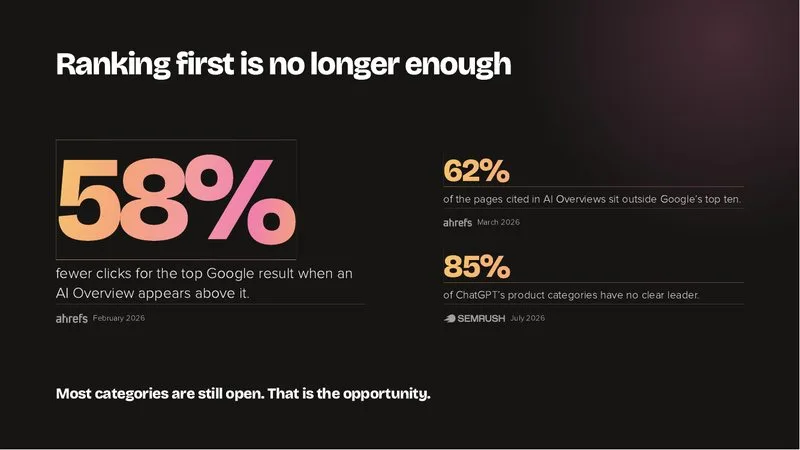
And Google is where most of the AI-influenced traffic is. Previsible’s 2026 State of AI Discovery report found discovery inside Google’s AI Overviews and AI Mode represents more AI-influenced traffic than every standalone assistant combined, while ChatGPT sends the vast majority of the referrals you can track from standalone assistants. So you’ve got two games. In ChatGPT, press coverage is the raw material. In Google, it’s brand mentions across the web (Ahrefs found mentions matter about three times as much as backlinks there) and being cited directly, which Seer Interactive found gets you about a third more organic clicks than not being cited. The good news is that decent coverage feeds both. The bad news is that you have to check both.
What this means if you’re a brand
Get in the papers, described accurately. Aim for coverage that describes you in a way you’d be happy to have repeated by a machine to a stranger for the next year. The exact words a journalist uses about you are the words the answer will use.
Pitch the right people. Muck Rack’s December 2025 report found the overlap between the journalists brands pitch most and the journalists AI engines actually cite for that brand is tiny, a couple of per cent. Most PR effort is aimed at the wrong desks for this job. Collect the sources the AI tools show you, and work backwards from them.
Keep showing up. One campaign a year won’t do it when half of what gets cited is less than a year old. Reactive PR, expert comment, product placements in the round-ups, month after month.
And stop thinking of this as a tech problem. I build tools for a living and I promise you the answer isn’t a tool. The answer is being the brand a journalist wants to write about, in a publication a model trusts, this month. That was always PR’s job.